
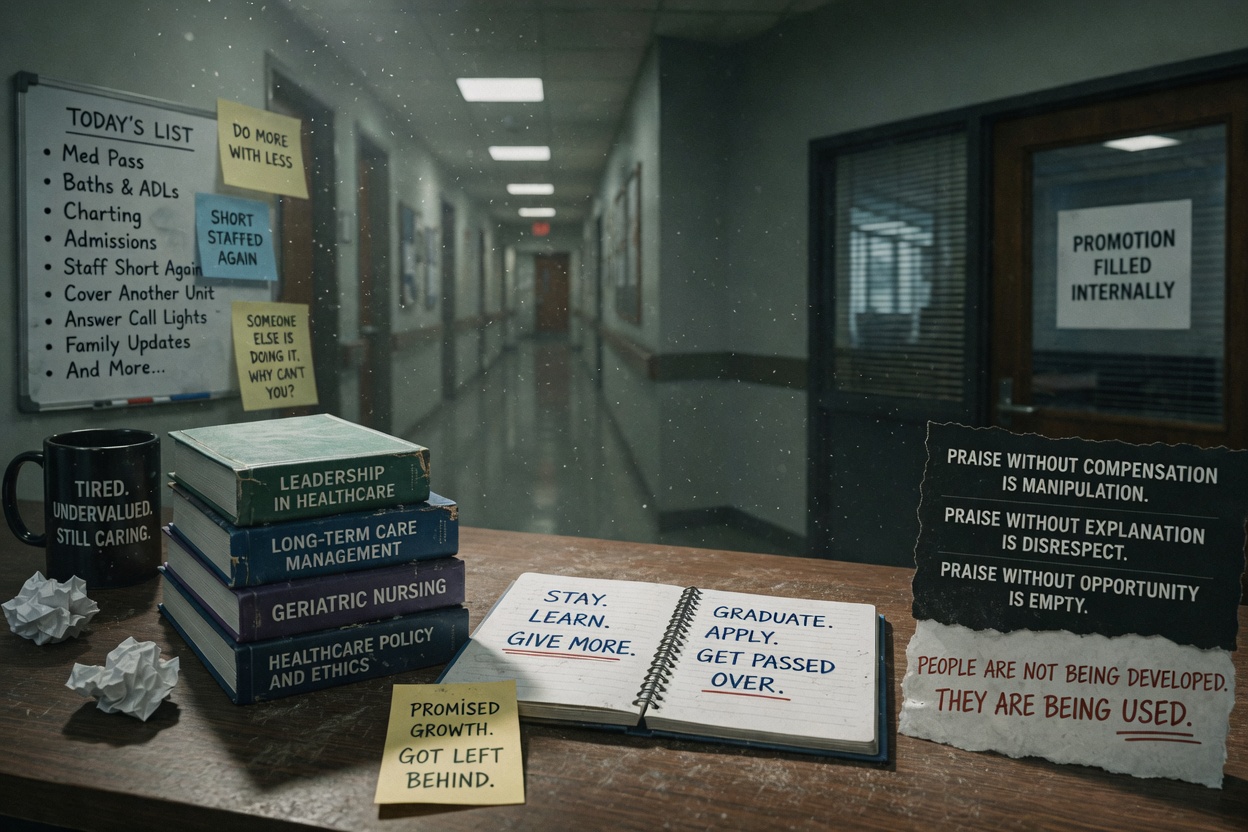
This is the part people in healthcare are saying out loud more and more, especially those working in nursing homes: the system keeps asking for more, giving less, and dressing exploitation up as opportunity.
People are expected to solve problems they did not create. Take on duties they were never properly prepared for. Carry extra responsibilities without explanation, without support, and very often without compensation. And if they dare question it, the answer is almost always the same in one form or another: someone else is doing it, so why can’t you?
That is one of the oldest tricks in the book.
Because not everybody responds to pressure the same way, management can hide behind comparison. One person stays quiet, another speaks up, another struggles in silence. Instead of seeing that people have different limits, different pressures, and different ways of coping, the workplace turns that difference into a weapon. If one colleague accepts the extra load without complaining, everyone else is expected to do the same. Silence becomes the standard. Suffering becomes the standard. Overextending yourself becomes the standard.
And then people wonder why so many are burned out.
I have seen what this pressure does up close. I once witnessed a colleague break down because of it. Not because they were weak. Not because they could not do the job. But because there is only so much a person can carry before something gives. They had been taking on extra tasks, covering gaps, pushing through constant pressure, and trying to keep everything together. On the outside, it probably looked like they were managing. But one day, it all spilled over. The tears, the frustration, the sheer exhaustion. It was the kind of breakdown that does not come from one bad shift. It comes from being stretched past your limit again and again while everyone keeps acting like it is normal.
And that is exactly the problem. Too much of this is treated like normal.
Then comes the second trap: education.
Workers are encouraged to take courses, degrees, and training. It is presented as development. As growth. As investment. As proof that the organization wants to see you move forward. And to be fair, that may not be false everywhere in the health sector. But in nursing homes especially, this pattern shows up far too often to ignore.
People go back to school while still working. They sacrifice their time, energy and rest because they believe it will lead to something better. They stay loyal because they think they are building toward the next level. They believe the message: keep going, keep learning, keep giving more, and there will be opportunities for you.
Then they graduate.
Suddenly, there is no vacancy for their level.
Or they are told they do not have enough experience for the very role they were led to believe they were preparing for.
Or the position somehow goes to someone else entirely.
And just like that, the promise disappears.
That is why so many people no longer see this as encouragement. They see it as a disguise. A strategy. A way to keep workers hopeful, committed, and useful for as long as possible. Education becomes the bait. Advancement becomes the illusion. The real benefit often goes to the employer, who gets a worker that is more skilled, more loyal, and more willing to stay, all while keeping them exactly where they are.
That is the ugly part.
Because when education is used mainly to make people stay and work harder, instead of genuinely creating pathways upward, it stops being opportunity. It becomes control.
Of course, there may be other sides to this. Budget limitations exist. Staffing structures exist. Internal politics exist. Not every workplace handles it the same way. But that does not erase what keeps playing out in real life, especially in nursing homes: workers are pushed to do more, encouraged to study more, promised growth indirectly or directly, and then bypassed when the time comes.
Meanwhile, the extra work never stops.
The problem is not that people are unwilling to grow. The problem is that growth is too often used against them. Their dedication gets exploited. Their flexibility gets abused. Their willingness to improve becomes one more thing the system knows how to extract from them.
And the worst part? Many of these same workers are still praised constantly. Told they are valued. Told they are appreciated. Told they are doing amazing work.
But praise without compensation is manipulation.
Praise without explanation is disrespect.
Praise without opportunity is empty.
This is why so many people are speaking up now. Not because they suddenly became negative. Not because they do not care. But because they are tired of watching unfairness get repackaged as teamwork, loyalty, and professional development.
In too many nursing homes, people are not being developed. They are being used.
And the more the sector pretends not to see that, the louder this conversation is going to get.
At some point, people stop believing the motivational language. They stop being impressed by “opportunities.” They stop trusting the promise that hard work will eventually be rewarded. Because too many have already lived the truth: they gave more, learned more, carried more, and still got left behind.
That is not professional growth.
That is a trap.

Leave a Reply